Le digital Boudoir — About ethics, bodies and what I removed
On building something you can stand behind.
What the project is
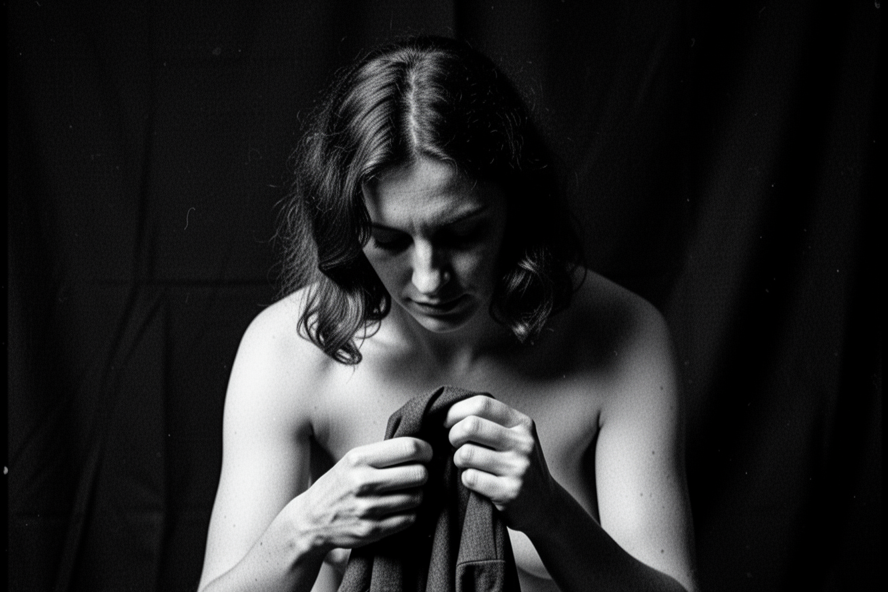
Le Boudoir Digital is an AI-generated artistic nude series. It is a love letter to women — made by a man who loves women and sees no point in pretending otherwise.
The figure is never performing for the viewer. She exists in her own psychological space, present and absorbed in whatever is happening inside her. The nudity is not the subject. It is the condition under which something else takes place.
That framing was in place before the first image was generated. It is the foundation, not an afterthought.
What the prompts actually are
Most AI image prompts are descriptions. A list of things to render — a woman, a chair, a light, a mood. That's not what these are.
Every prompt in this project is written as a declaration of intent. The STATE blocks — the psychological states assigned to each figure — are not descriptive tags. They are small pieces of prose that ask the model to hold a specific inner life while it builds the image. She carries something unresolved. The body holding what the mind hasn't processed yet. That's not a visual instruction. It's a request for interiority, addressed to whatever is listening.
It works — partially, inconsistently, in ways that are hard to measure. But the images that land are the ones where something invisible made it through. A weight in the shoulders. A quality of stillness that isn't emptiness. You can't prompt that with keywords. You have to mean it and write it like you mean it.
The same logic applies whether the model is Flux 2 or a language model helping build the architecture. Intention in, intention out — or at least, a better chance of it.
What I changed, and why
Two things happened recently that made me stop and look carefully at what I was building.
The first was technical. The figures were coming out heavier than intended — not because of a flaw in the model, but because of how I had written the prompt. Certain words I had placed in the fixed anchor — meant to signal realism and honesty about bodies — were statistically pulling toward a narrow range of morphologies. The prompt architecture has been rebuilt: the body anchor now speaks only to texture, gravity, and the absence of retouching. The morphology variants describe each body type as a positive, autonomous state rather than a variation on a default. It is a small change in language and a meaningful one in outcome.
The second was personal and harder to articulate. The Pelicot trial. Following the coverage made me look at every psychological state I had defined for the figures and ask, honestly, whether anything could be misread. I found one category: sleep and unconsciousness states. They were framed carefully — as rest, as post-intensity stillness. But I removed them anyway. Not because someone asked me to. Because once I had asked the question, I didn't want them there anymore.
A figure with closed eyes is not asleep. She is somewhere inside herself — thinking, feeling, present in a way that doesn't require her eyes to be open. That distinction is visible in the image when the rest of the body carries it. It matters.
A constraint applied from outside is a rule. A decision made from inside is something else.
What stays
The core doesn't change. The figure is always awake, always present to herself, always the subject of her own psychological state rather than an object in someone else's frame.
Nan Goldin remains the ethical reference — not stylistically, but in terms of what it looks like when a gaze genuinely loves what it sees. Her subjects are in the photograph, not placed in it.
The gaze here is masculine and I'm not going to obscure that. What I can try to do is make sure it's a gaze that respects what it looks at. That's the ongoing work.
Member discussion